Access Control with ConsoleWorks

January 3, 2013Comments Off

By Tom Kearns

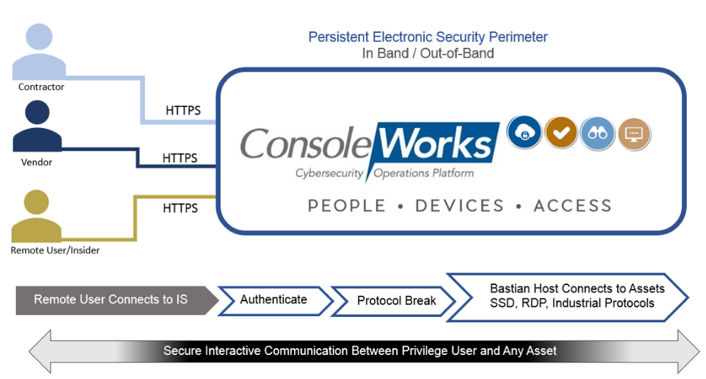
When it comes to security, ConsoleWorks offers many unique features to ensure consistent security practices across the entire IT infrastructure, including robust Access Control capabilities using a role-based/task-based permissions model.

Privileged users should be able to access only those interfaces needed to perform their work. Role-based access and control in the IT foundation ensures that interfaces cannot be accessed without permission. Users only see the interfaces assigned to them.

ConsoleWorks provides advanced role-based access and control capabilities with LDAP integrations for fine-grained control of access rights and privileges across all managed connections. Access Control Rules enable administrators more granular and graduated control over what specific users can do inside ConsoleWorks and how they can use ConsoleWorks to access and interact with managed assets.

In ConsoleWorks 4.6, the permissions model has been completely re-engineered. Significant enhancements have been made with new capabilities that allow very granular control over what any one person is allowed to do in ConsoleWorks, particularly with separation of duties. Read more about Access Control in the latest version of ConsoleWorks here: Permissions Model in ConsoleWorks 4.6

Security and Compliance in Virtual Environments

November 26, 2012Comments Off

By Tom Kearns

The use of Virtual Machines (VMs) in IT introduces a new layer of complexity in the IT infrastructure, and adds new challenges to IT operations, security, and compliance. ConsoleWorks is unique in that it delivers the same simplification, automation, documentation, and security benefits to virtualized environments as it does to physical ones.

ConsoleWorks maintains console connections in all modes of operation – including during VM migrations. ConsoleWorks uses persistent connections that move with VMs, keeping operations, compliance, and security practices over privileged interfaces consistent and effective.

In addition to maintaining the IT infrastructure security model over privileged interfaces (such as consoles and virtual serial ports), ConsoleWorks is also able to capture all log file data generated by hypervisors (including VM logs). The records produced are accurate, consistent, and comprehensive – and they remain so, even when VMs move from host to host. This comprehensive data collection can support even the most rigorous compliance requirements and provide the transparency needed to meet audits.

For more information, read
The ConsoleWorks® Difference – Virtual Machines

Improved Security Practices with ConsoleWorks

November 5, 2012Comments Off

By Tom Kearns

When it comes to security, ConsoleWorks offers many unique features to ensure robust and consistent security practices across the IT infrastructure.

ConsoleWorks maintains a persistent, secure connection to physical and logical infrastructure to monitor user actions, machine activity and all defined incidents worth knowing about. Various levels of physical and logical security are implemented to provide necessary – and often required – protective measures.

ConsoleWorks also enables strong password implementation, access restrictions by task, by role and by policy, and user authentication internally and externally. The solution offers two communication security options, SSL and SSH, which provide for the exchange of encrypted information between the browser (SSL) or the CLI (SSH) and the ConsoleWorks server, and between the ConsoleWorks server and the managed asset (SSH).

The ConsoleWorks solution supports a robust task-based/role-based privilege model based on user-defined Access Control Rules. These Access Control Rules give administrators more granular and graduated control over what specific users can do inside ConsoleWorks and how they can utilize ConsoleWorks to access and interact with managed assets.

Read more about The ConsoleWorks® Difference – Security

Page 1 of 912345»...Last »
Google Analytics Alternative